What happens when a tax bill for thirteen thousand dollars shows up thirty days after closing, addressed to someone who just moved in?
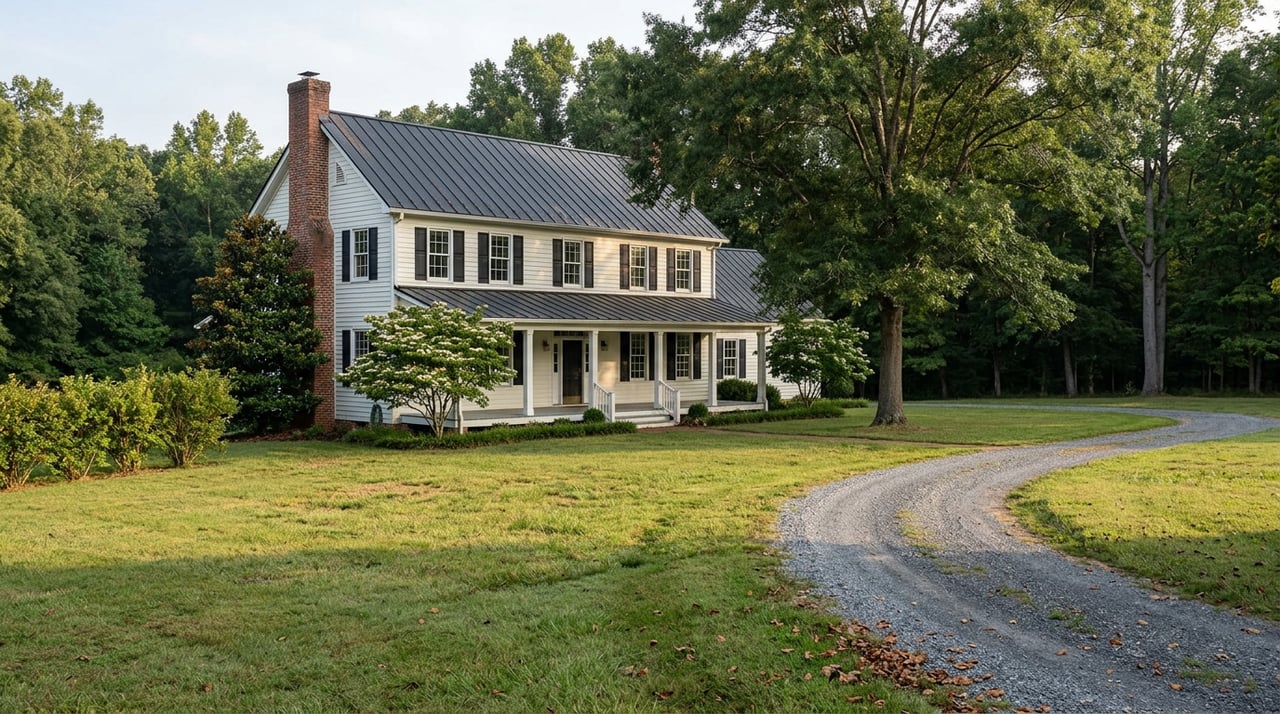
That is the question worth asking before you fall for an eight-acre lot in Ivy Farms on the strength of its tax line alone. Ivy Farms is one of the rare Albemarle neighborhoods where the appeal is written in acres, not square footage. Homesites here run from a few acres up to ten or more, carved out of Virginia farmland just off Garth Road near Foxfield, with most of its traditional farmhouses, colonials, Dutch colonials, and Cape Cods built between the 1970s and the 1990s on wooded or open lots. Buyers comparing it to a tighter-lot subdivision closer to town usually do the same math: more land, more privacy, and somehow a tax bill that looks almost gentle for the size of the parcel. That gentleness is often not a bargain. It is a deferral, and deferrals come due.
The Line on the Listing Sheet Nobody Reads Twice
Virginia lets counties tax certain land based on what it produces rather than what it would sell for on the open market. Albemarle County runs this as its use-value assessment program, and the gap between the two numbers is the whole point. A parcel farmed for hay or kept in managed pasture can carry a use-value tax bill far below what the same acreage would owe if assessed at fair market value.
That discount is not free forever. Albemarle's own program guidance states that when a qualifying use ends and is not replaced by another qualifying use, the deferred taxes have to be rolled back and paid by whoever owns the property at the time, whether or not they were the one who benefited from the original deferral. The rollback is not a token penalty. The county's guidance puts the total roughly at 6.5 to 8 times the annual taxes on the affected portion, with the full payment due within 30 days of billing. Virginia Code section 58.1-3237 backs this up at the state level, setting the rollback at the sum of deferred taxes for the five most recent complete tax years plus interest.
None of this shows up as a red flag on a listing sheet. It shows up as a low number in the tax column, which is exactly what makes it easy to miss.
Why an Ivy Farms Lot Is a Plausible Candidate
Not every large lot qualifies, and the acreage minimums matter more than most buyers expect. Albemarle sets its own thresholds by category:
| Qualifying Use | Minimum Acreage in Albemarle | Fit for a Typical Ivy Farms Lot |
|---|---|---|
| Agricultural | 5 cleared acres | Plausible on the larger parcels |
| Horticultural | 5 cleared acres | Plausible on the larger parcels |
| Forest | 20 acres | Unlikely, most lots top out near 10 acres |
| Open space | 20 acres, an Albemarle-specific threshold | Unlikely for the same reason |
That table matters because Ivy Farms sits right at the edge of qualifying territory. A one or two-acre homesite in the neighborhood has no realistic path to land-use status. An eight or ten-acre parcel with a cleared pasture or a managed hay field does. The county's guidance is also specific that homesites, meaning lawns, driveways, and landscaped areas, are excluded from the qualifying acreage regardless of category, and that a rollback is assessed at minimum on a two-acre homesite the moment a building permit is pulled for a new home. A lot large enough to carry both a house and a working field is exactly the shape of property where this program tends to live quietly in the background.
What Actually Triggers the Rollback
The rollback does not fire on its own. It fires on specific actions, and several of them are things a new owner does without realizing the acreage was ever enrolled:
- Pulling a building permit on land beyond the minimum homesite carve-out
- Clearing a pasture or hayfield for a pool, a lawn, or a guest house
- Letting agricultural or horticultural production lapse without a replacement qualifying use
- Missing the annual revalidation deadline, which the county requires to keep a parcel in the program
- Assuming enrollment transfers automatically at closing, when in fact a new owner has to file to keep it going
The Virginia Tech program that administers land-use guidance statewide is direct on this last point: land becomes subject to rollback taxes and penalties when there is a change to a nonqualifying use or a change in acreage, and the responsibility to notify the local assessor sits with whoever owns the parcel when the change happens. Buyers who lean on a prior owner's land-use status without confirming it survives the sale are the ones most likely to be surprised.
The Math Behind the Multiplier
Picture a parcel where the acreage portion carries a deferred annual tax bill of roughly $2,000, which is a plausible figure for several cleared acres under Albemarle's use-value assessment. Apply the county's own 6.5 to 8 times multiplier and the rollback lands somewhere between $13,000 and $16,000, due in a single payment within 30 days of the bill. That is not a number most new owners have budgeted for in year one, especially if the trigger was something as ordinary as breaking ground on a pool or converting a hayfield to lawn because the buyer never intended to farm the property in the first place.
This is an illustration built from the county's published multiplier, not a specific transaction. The exact figure on any given parcel depends on its enrolled acreage, its assessed use value, and how many years of deferral have accumulated. That is precisely why it needs to be checked before an offer goes in, not discovered after a permit is filed.
Reading the Rest of 2026 Through This Lens
Albemarle's second-quarter 2026 numbers show a market with more room to breathe than it has had in several years. Closed sales rose 11.6 percent from the same period a year earlier, active listings jumped 45.7 percent, and months of supply climbed to 4.2. That is a meaningfully looser market than the frenzy years, and it gives buyers more time to ask questions before signing anything.
The catch is that the loosening has not slowed the pace of the properties people actually want. The median sold price held nearly flat at $570,000, down less than one percent, while the average sold-to-list ratio stayed at 99.6 percent and the median days on market held at 7 days. Sellers are still getting close to full asking price, and desirable homes are still moving in about a week. For a segment like Ivy Farms, where the acreage itself is the draw, that combination means a buyer with genuine interest does not have the luxury of a slow due diligence period once a good listing appears. The land-use question has to be part of the first conversation with a listing agent, not a follow-up call after an offer is already in.
What This Changes About the Comparison
Buyers weighing Ivy Farms against a tighter-lot neighborhood closer to town are usually running a simple trade: more privacy and more land against a shorter commute and a smaller yard. The tax line on the listing sheet often reinforces that trade, making the acreage look like it comes at a discount. If part of that discount is a deferral rather than a permanent rate, the comparison changes. The real cost of owning an Ivy Farms parcel is not the number on last year's tax bill. It is that number plus the probability that maintaining the land as-is, or re-enrolling it under your own name, is part of what you are actually buying.
A Short FAQ
Does land-use enrollment carry over automatically when a property changes hands? No. The classification does not transfer with the deed. A new owner has to file to keep the enrollment active, and Albemarle requires that changes in use, acreage, or zoning be reported to the local assessor.
How can a buyer check land-use status before writing an offer? Ask the listing agent whether the parcel is currently enrolled in Albemarle's use-value program, and confirm directly with the Commissioner of the Revenue's office. This is a matter of public record and worth verifying before, not during, the due diligence period.
What's the practical timeline if a rollback is triggered? Under Albemarle's guidance, the full rollback payment is due within 30 days of billing once a qualifying use ends without a replacement. That is a short window to absorb a bill that can run several times the annual tax on the affected acreage.
This piece is general education about a public program, not tax or legal advice, and every parcel's actual status should be confirmed with the county before any decision is made.
If you are weighing Ivy Farms against other Albemarle neighborhoods and want someone to help you ask the right questions about a specific parcel before you write an offer, the Bobby and Alex Schwartz Team has spent years working both sides of this market, from acreage properties to in-town listings, and can walk you through exactly what a given lot's status means for your offer. Contact Us to start that conversation before you fall in love with the acreage.