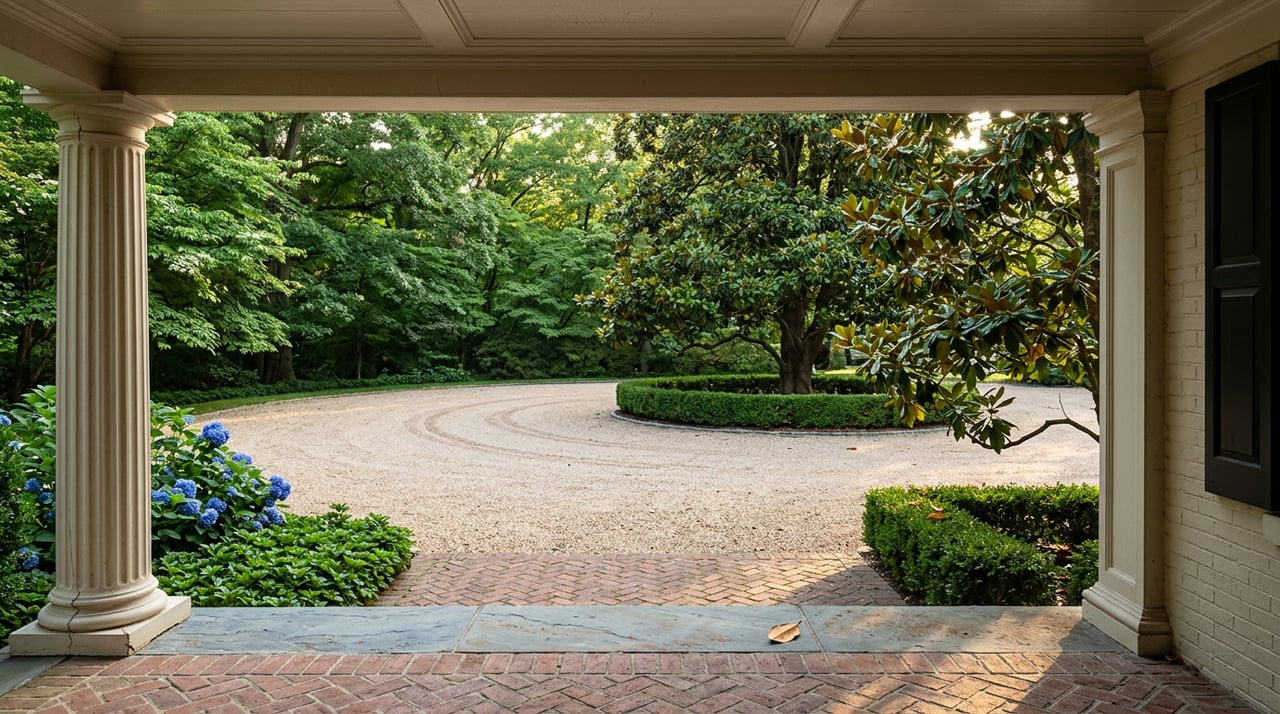
A relocating buyer tours a brick Georgian off Farmington Drive on a Saturday morning, walks the boxwood-lined approach, sees the fairway through the trees, and does the math on a life that includes standing tee times and Sunday lunch on the terrace. By Monday, an offer is in. By closing, the buyer learns that the golf, the pool, the tennis courts, and the dining room belong to a separate transaction that has not yet begun, and may not conclude on any predictable timeline.
The thesis of this post is simple: in Farmington, the house and the club are two purchases, priced separately, decided by two different sets of people. Buyers who treat them as one line item are the ones who overpay, or who arrive disappointed.
The friction that catches buyers off guard
Farmington Country Club sits at the emotional center of the neighborhood. It is also, legally and administratively, a distinct institution from the surrounding subdivision. The club itself is direct about this: membership in Farmington is by invitation only, in keeping with the tradition of a private country club. Buying a house on a lot that touches the golf course does not confer membership. It confers the right to apply, subject to the club's own process.
Industry data collected by Golf Life Navigators, a private-club advisory service, estimates initiation in the $50,001 to $75,000 range and annual dues between $5,001 and $10,000, spread across full golf, social, junior executive, and family categories. Those figures are estimates, not a published rate card, and prospective buyers should confirm current numbers directly with the club before writing an offer that assumes access.
There is a second, smaller line item that does convey with the deed. The Farmington Property Owners Association carries annual dues of $990 and a $5,000 Farmington Association set-up/transfer fee at purchase, and those POA dues cover area maintenance, master insurance, a reserve fund, road maintenance, a security force, and snow removal. That is the neighborhood. The club is separate.
Two purchases, side by side
| What you buy | What it costs at closing | What it delivers |
|---|---|---|
| The house | Purchase price plus $5,000 POA transfer fee | The residence, the lot, road maintenance, private security patrol, snow removal |
| The club | Separate initiation, paid only if invited and accepted | Golf, racquets, aquatics, fitness, dining, social calendar, guest rooms |
Reading the two lines side by side is the exercise most Farmington buyers skip.
Reading the 2026 market through a very small neighborhood
Farmington is compact. There are 123 homes in Farmington, the majority built between 1950 and 1980 on lots ranging from 1.5 to 6 acres. That is the entire supply. In a normal year, only a handful trade. When one does, the transaction moves quickly: since January 1, 2025, one Farmington home came to market and sold within two days at $4,995,000 (2715 Farmington Heights), and the median days on market was 8.
The regional backdrop makes those numbers more, not less, meaningful. Through June 21, 2026, 961 resale homes in Albemarle and the City went under contract, compared with 892 in the same window last year, roughly 8% more buyers reaching ratified. The typical home took 13 days to go under contract this year, up from 11 last year, a modest cooling relative to national headlines. Charlottesville was recently ranked Virginia's least affordable housing market, with a typical home value just over $534,000 and an income-to-price ratio of roughly 7.6 years of Virginia's average annual salary.
Set that median against Farmington and the shape of the neighborhood becomes clearer. The area median is what a working family buys after saving for years. Farmington trades at multiples of that number for a house of the same square footage elsewhere in the county, because the buyer is paying for setting, architectural pedigree, and adjacency, not for a bedroom count. Every dollar over the county median is a bet on the address and the potential of the club, in that order.
What your money actually buys inside the neighborhood
Farmington homes are not interchangeable. The setting of the lot drives more of the price than the finishes inside, and the era of construction drives more of the renovation math than most buyers expect.
- Golf-front lots trade at a premium and carry a specific tradeoff: quiet mornings, occasional stray balls, and clear sight lines from the course into the rear of the property.
- Wooded interior lots are the quiet workhorse of the neighborhood, priced below the fairway lots but offering the privacy that mature Farmington trees are known for.
- Mountain-view lots, generally on the western edges, command their own premium and can compensate for a smaller or older house.
- Older homes, particularly those from the 1950s and 1960s, often need mechanical, envelope, and kitchen updates that read cosmetically minor and cost meaningfully more than the same work in a newer subdivision.
The clubhouse itself sets the tone for the neighborhood's architectural expectations. The club opened in 1929 on the grounds of the Farmington estate, patented in 1735, and in 1802 Thomas Jefferson drew plans for an addition to the main house that has been preserved as the Jefferson Room. The campus sits on 286 acres shaded by mature trees, with championship golf, racquet sports, aquatics, fitness, dining, and 40 guest rooms. A house being marketed as "Farmington" is being marketed against that standard, whether or not the seller has kept the property to it.
Where relocating buyers most often get this wrong
Buyers arriving from Washington, New York, or Atlanta tend to compare Farmington to gated country-club communities where deeded membership travels with the parcel. That is a different real estate product. In Farmington, three assumptions tend to cause the most avoidable friction at the negotiating table.
- Assuming the seller can transfer their membership. They generally cannot. The club membership is between the individual and the club, not attached to the certificate of title.
- Assuming a fast timeline into the club. Because membership is by invitation only, the timeline from offer to first tee time is not something a listing agent, a buyer's agent, or the seller can compress. Planning a wedding, a family reunion, or a first summer around the pool before that process concludes is a mistake.
- Assuming the house price already reflects club access. In practice, comparable Farmington sales include buyers who joined the club, buyers who applied and are waiting, and buyers who never intended to. Sorting those groups is part of the pricing analysis on any specific property.
The interpretive move for a serious buyer is to price the house on the real estate fundamentals, treat the club as a separate line item with its own probability and cost, and let the sum of the two numbers govern the decision.
Small comfort in the market data
The RealCentralVA analysis of the first half of 2026 offered one line worth carrying into any Farmington offer: the median is a story about the market, not a story about you, your price band, or your situation, and the analysis worth having is the one run for your address instead of two counties. For a neighborhood of 123 homes, county-level medians and days-on-market averages are context, not comps. The actual comps are the last handful of Farmington sales, read against the specific lot, era, and condition of the house you are considering.
A short FAQ
Does buying a home in Farmington guarantee me a spot at the club? No. The house and the club are two separate transactions. The club retains its own invitation and approval process.
What does convey with the house? Membership in the Farmington Property Owners Association and the services those dues fund: road maintenance, master insurance, a reserve fund, security, and snow removal, at $990 annually with a $5,000 transfer fee at closing.
Is Farmington gated? The community is not a gated subdivision. Public roads run through parts of it, and the POA-funded security force patrols the neighborhood.
How old is the housing stock? Most of the roughly 123 homes were built between 1950 and 1980, with a small number of older estate homes and a handful of newer custom builds. Renovation budgets should reflect the era of the specific house, not the neighborhood average.
What should I do before making an offer? Confirm current club initiation and dues directly with Farmington Country Club. Ask your agent for a lot-specific comp set, not a Farmington-wide average. Have the POA transfer fee and dues added to your closing worksheet.
Working with the neighborhood, not the brochure
Farmington rewards buyers who separate the real estate from the lifestyle, price each one honestly, and make peace with the fact that both take time. That is the kind of transaction the Bobby and Alex Schwartz Team is built to run: a lot-specific pricing analysis, a clear-eyed conversation about the club, and a negotiation that reflects what you are actually buying at the closing table. If Farmington is on your shortlist, reach out before you tour the next house. The best time to understand what conveys, and what does not, is before the offer, not after.
Contact Us to talk through a specific property, a specific lot, or the current inventory in Farmington and the surrounding Ivy corridor.